Tag: Social Media

  • Social Media Stats are Useless

    I do social media all day.

    Which means that all of the myriad social networking support groups and blogs and websites and feeds that I follow each come out with their annual statistics on the size and scope of social media and what trends are coming and who’s swinging the most wood after raising Series C funds. And there’s usually a drop-shadow-less infographic that tells me some tip about how to make my pins more pin-tastic and that 65.4% of all B2B partnerships thrive due solely to LinkedIn conversations.

    And I read them all. Because it’s my job.


    And I’ve yet to glean ANYTHING useful out of them.

    1,440,000,000 people on Facebook. 77,600,000 Instagram users in the US. 4,000,000,000+ views on YouTube every day.

    Lovely. Wonderful. But what does that do for my organization? Nothing.


    The problem comes down to the maturation of social media. When the field was young and needed to prove itself, it sold eyeballs. How many people can see your posts!? Follower counts were like gold. Every time the “Facebook nation” rose up the ranking list of most populous countries, we forwarded those stats to our executives and pleaded to stop being kept from the promised land.

    But now, when I post to Facebook, when I want to talk to the 3,876 people who have taken a half a second to click that happy thumbs up icon on our Page, when I have something that could potentially save their lives, their health, their humor, and/or their sanity, I’m lucky if 387 people ever see that post.

    Sad Clown Mark Holthusen Photography. Photography by Mark Holthusen

    Maybe I’m not as funny as I think I am. Maybe not.

    Today, though, I’m not concerned with how many people could see my posts. Telling me there are 15,000,000 pairs of eyeballs out there waiting for my posts doesn’t do anything for me. Because I know 15,000,000 pairs of eyeballs aren’t waiting for me.

    What’s waiting for me are the twenty people in my city that are thinking about quitting smoking today. Or the 4,000 people that would be interested in free yoga on the Parkway. Or the 150 that need to be reminded not to leave their kids in the car because it’s 95 degrees out.

    We need new metrics on engagement and interaction. We need new advice for today’s social media. So I call on you, Social Media Expert/Maven/Ace/Superhero Person/Group/Blog (honestly, I tried so many combinations there, but they’re all already taken by real people)! Instead of selling us on how to get 10 zillion views using your One Simple Trick! on social media, help us learn how to find the right people and get the right people to ENGAGE with our social media.

    Until you guys start doing that, I’m swearing you off. I’ll make my own damn social media best practices that work for my audience.

  • Rethinking Government Communications

    Communicating today is tough for anyone trying to do it. It used to be easy. Craft a message in a pre-approved format (inverted pyramid, anyone?), then give it to pre-approved people, then Miller Time. Today? Not so much.

    Lots of us still do it that way, though. And in lots of cases, it’s not because we don’t want to do more. Or be more targeted. Or take advantage of all of the new avenues of communication. It’s just that we already have full time jobs, and inadequate staff, and not enough money. (Welcome to government, my friend.)

    Adding Facebook to our portfolio was a tough enough sell. Now you’re telling me that Medium is another thing to add, and I need a Meerkat, too? And I’m going to sell the idea of a live-streaming rodent to my bosses exactly how? It sucks, no doubt.

    The real problem, though, isn’t that we aren’t doing these things. We’re providing the level of output that we’ve always done, and have done successfully. No, the real problem is that others are doing these things, going the extra mile.


    You think I’m joking about Obama? Hardly. He really is the problem. At least for overworked government communicators. The White House today is setting the stage for how government can communicate, and pretty soon, the rest of us will be expected to do the same.

    With that in mind, you can see the looming conflict between government capacity and public expectation. We will be seen as failing our constituents for simply doing what we’ve always done, even though we haven’t been given the capacity to meet those increased expectations.

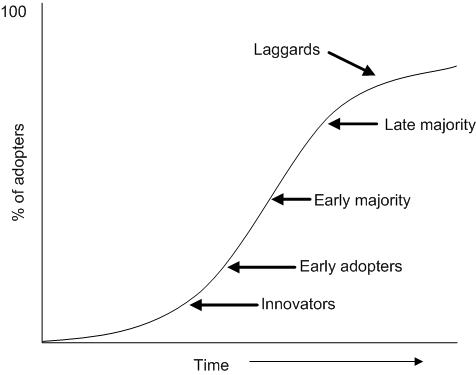
    The solution is easy to see; it is harder to do. It is basically us adopting this new worldview and adapting our work to the expectations of the public. How I imagine it will happen will look like a diffusion of innovation curve.


    Our innovators are the folks on the CDC social media team, at the White House, and at NASA. Early adopters are just now starting to learn how best to create media. The rest of us, though, while we’re usually perfectly happy to be part of the early or late majority, are in danger of falling out of step with the public. If we haven’t already.

    What’s needed, then, is a radical reimagining of how small, traditionally underfunded government agencies present themselves to the world. That S-curve up there won’t help. The how, again, is perplexing. How do you change everything in a field that is almost completely hesitant to change?

    How about this: if you can’t change the end result, instead consider changing the process. If we can’t expand dedicated communications staff to meet the expanded communications burden, why not expand the definition of our communications staff? Why not decentralize a lot of the day-to-day social media work to those best placed to tell those stories? Yes, let regular employees get online and tweet and livestream and give the public a view into what goes on in their agencies’ work.

    Scary? Absolutely! But, given the choice between being completely out of touch with our audiences, and having non-communications people talk about what they do everyday… Well, which is really worse in the long run? The details and rules and training definitely need to be worked out, but given how quickly we can lose the ear — and trust — of the public, isn’t it worth the risk?