Category: Uncategorized

  • The Changing Nature of Emergency Public Information

    Media_httpmediagovtec_cavfe

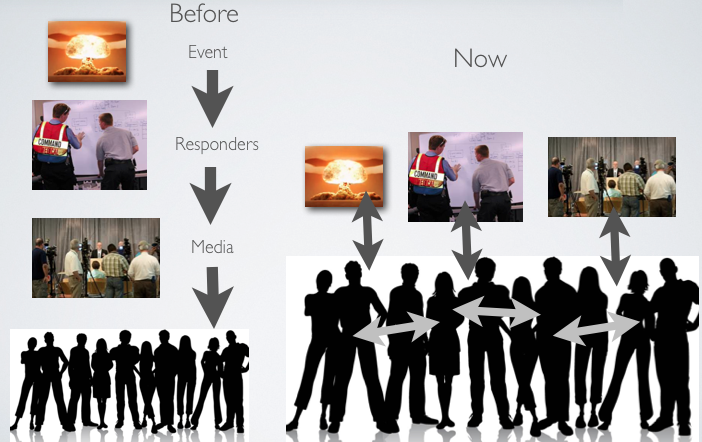
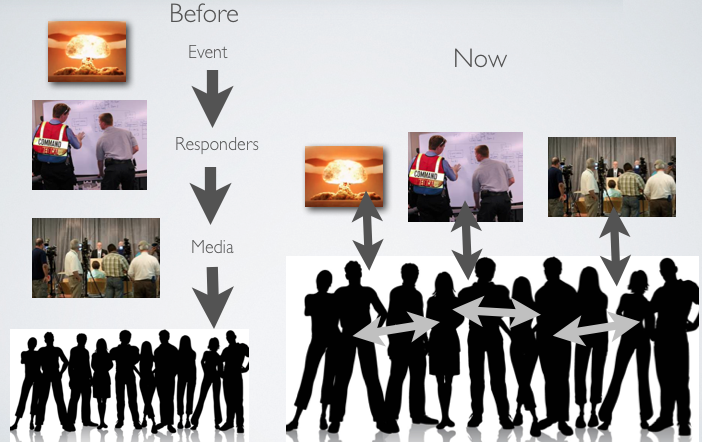
    Taken from a recent presentation by Gerald Baron, this is a great, simple representation of the fundamental change taking place in emergency public information.

    It reminds me of a story from a training I took yesterday on the NRT JIC Model given by two Coast Guard PAOs. One of the PAOs related a story of a minor oil spill he responded to early in his career. The response issued a press release on the spill and clean up; he felt that if they didn’t, only a handful of people would have known about it. They considered not even issuing that release. Do you think you could have a spill in a navigable waterway today and seriously hope that no one notices? Exactly.

    Fundamental change.

  • The Public Information Go Bag Updated

    In the past, I’ve talked about building a go bag for public information
    officers
    . The
    idea came from the FirePIO blog, and
    was supplemented by the great Mike Staley from CDC. Well, now I’ve got an update. I’ve got a
    brand new bag, as Mr. Brown would say.

    Everything listed here is in addition to my more general preparedness stuff
    (e.g., whistle, blanket, flashlight, car kit, etc.) and is supposed to
    specifically support a public information emergency response. Not everything
    listed will be useful in every situation, but it works for me (consider a
    public health emergency vs. a conflagration or law enforcement response or
    corporate/PR crisis). I think, though, that the bones are there and this kit
    will enable you to grab and go into any JIC or war room ready to contribute.

    The reason it’s taken me so long to follow up on that original post is
    because I’ve been struggling with storage. I wanted something that was
    compact, easy to grab, and could hold everything with a minimum of fuss.
    Thanks to a post at BoingBoing.net, I think I found
    something that works: the AmazonBasics Universal Travel Case. Just $15, and I got it within
    two days, it carries everything.

    Case closed

    Case open

    Here’s what I mean by everything:

    • Flip-type video camera (Kodak Zi6)
      with 4 GB SD card (for four hours of continuous recording)
    • Old digital camera with 4GB SD card (can hold hundreds of high-quality
      pictures)
    • Virgin Mobile Mifi card
      (Converts Sprint 3G network into wifi for up to five devices; great deal
      when I bought it: $40/Month unlimited bandwidth with no contract. Pay $40
      when you need it and you’ve got access for a month.)
    • Two Rite-in-the-Rain notebooks
    • Two Fisher space pens, slightly modified
    • Griffin PowerBlock dual USB charger
      (can charge both my iPad and my iPhone at the same time, or the Mifi and the
      emergency iPhone battery
      at the same time, or any combination thereof)
    • Magnetic Joby GorillaPod tripod
      (This can hold either the digital or the video camera and connects
      magnetically to anything metal—like hand rails, street sign poles, file
      cabinets, you name it. Great for setting up, hitting record and walking
      away.)
    • Two USB to iPhone retractable cords (for charging iPad and iPhone)
    • One USB to microUSB retractable cord (for charging Mifi)
    • One USB to miniUSB retractable cord (for recharging iPhone battery)
    • Two extra SD cards (2 GB each) in a case
    • SD card iPad Camera Connection kit (for transferring photos and
      videos to the iPad for editing with Photogene iPad app and use)
    • iPad VGA connector (for
      hooking up to projectors)
    • Business cards and emergency responder ID
    • Typed and laminated list of emergency phone numbers and email addresses
      (just in case)

    And here’s how I have everything stored, by section:

    Left pocket:

    Left pocket

    Top right pocket:

    Top right pocket

    Bottom right pocket:

    Bottom right pocket

    Behind right pockets:

    Behind right pocket

    And for size comparisons, here is the whole thing next to my iPad:

    With iPad

    With iPad askew

    When combined with my iPad (which has image editing software, video editing
    software, document editing software, PDF editing software, email, internet
    access, social media accounts and all of my reference materials), I’m pretty
    sure I’m ready for just about anything.

    Like I said above, not everything here is necessary for everyone, and there
    are things that you might need that I don’t (PIO armbands, for example). But
    hopefully this will give you a start on what you may need.

  • Writing for the People

    I am lucky to work with some of the smartest people in public health. Really, world-renowned in many cases, and more often than not, we hire people more intelligent than those whose role they are filling. Very, very lucky. And I’m reminded of this every time I read something written by one of my colleagues; it is invariably well-reasoned, well-organized, thoughtful, comprehensive and engaging.

    And then, many times, I have to rewrite whatever it is they wrote because only a public health professional can understand it.

    (And don’t let anyone tell you that rewriting a scientific piece for a general audience whilst still keeping the information correct isn’t a skill. It’s hard!)

    I recently came across an article that talks about the need to target public information pieces for the public they’re intended to reach. The author argues against the idea that the work we do is “dumbing down.” In fact, he says that by not writing at an appropriate level, we are making our audience feel “dumbed down,” like they can’t understand something that is obviously important enough for someone in government to write about it.

    I really appreciated this description of what subject-matter experts do when they resist rewriting of their prose:

    The writer is hiding behind their words, using them to conceal a lack of appreciation and respect for their audience and a lack of understanding of their topic. They are revealing their limits and fears – and they are not getting their message across.

    So, while I’ve never run into someone who’s vigorously opposed changing written materials, I know that there is some level of resentment felt. And I’m sure there are people out there who don’t appreciate why things are being rewritten, and may take that frustration out on communications staffers. The fact that dense materials are still available on government websites is a testament to the lack of plain language acceptance.

    My suggestion, if you’re in such a situation, is to reframe the problem. We’re not dumbing down language, we’re increasing the influence of the document by ensuring that everyone who sees it understands it and can implement the recommendations the subject-matter experts have developed. We’re making sure that everyone, regardless of level of education or language, can fully appreciate all of the hard work and time the subject-matter expert has put into developing the content. If people can’t understand it, they’re not going to read it or heed it. And in fields like public health and public safety, that might just be the most important part of the equation.