Category: Uncategorized

  • Timeliness is Next to Godliness

    Two questions:

    First, how long did it take–from conception to “Send”–did it take to get your last press release out?

    Second, how long did it take for a major situation to go from unknown to all over the news? (For an example, think of the Chris Christie bridge scandal or the Elk River, WV chemical spill.)

    If those two timeframes are close to each other. Even within a few hours, that’s not bad. I’m guessing, though, that for most of us, there is quite a difference.

    And that difference is of critical importance, as demonstrated by a survey by the American Red Cross from a few years back:
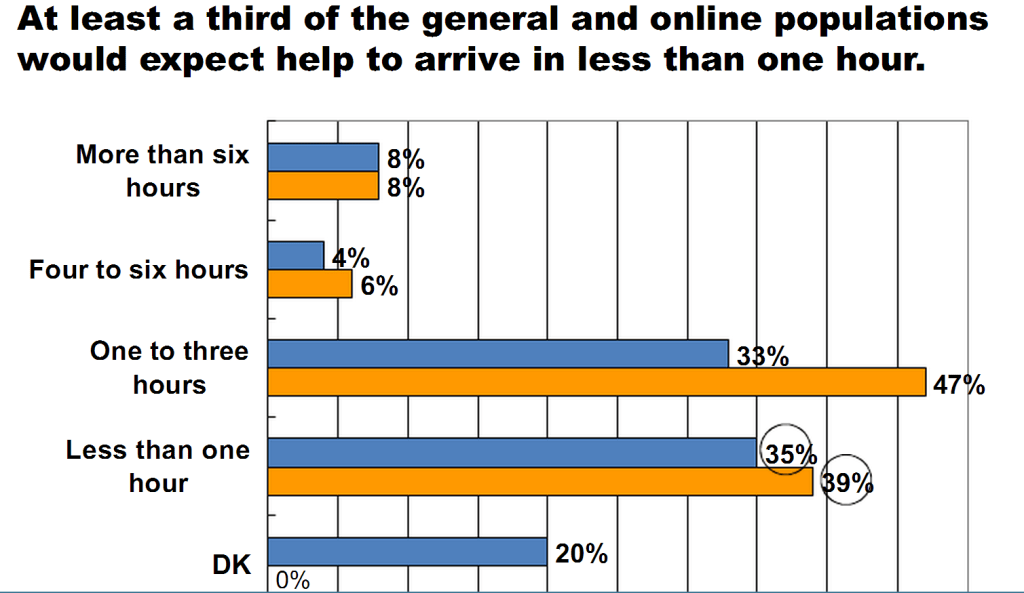
    red cross

    This chart is examining how long the public expects for help to arrive (that’s you, responding government agency), after a call for help has been posted online. Unfortunately, folks still haven’t taken this reality (and I imagine it’s only gotten worse since this was published in 2011) seriously:

    Most 140-character tweets issued by the department are planned weeks in advance; edited by dozens of public servants; reviewed and revised by the minister’s staff; and sanitized through a 12-step protocol, the documents indicate.

    That quote is taken from this National Post article on how Industry Canada doesn’t quite get social media.

    An insider at Industry Canada said the “super-rigid process” is frustrating, and simply doesn’t work for Twitter.

    He said he’s seen proposed light-hearted tweets killed at birth because they don’t fit the template.

    “What’s our problem with being lighthearted? Why do we have to be super-serious and boring, and dry all the time?”

    Hey, where have I heard that before? Oh, that’s right, I’m the one that rails against government automaton speak. The National Post asked for a comment from Industry Comment and what they got back, well, it kind of confirmed the whole deal:

    “Industry Canada follows the Treasury Board Standard on Social Media Account Management, which aims to provide a strategic and coherent approach for the management of departmental social media accounts,” said the email from Michel Cimpaye of media relations.

    “This Standard supports Canada’s commitment to open government and enables accuracy, greater information sharing, public dialogue and collaboration.”

    My point is this: whether or not we want them to, the public has developed an expectation of how social media works. It’s an expectation that’s been set by private companies that live and breathe off of their social media interactions, by friends and family that love to chat, by a couple government agencies and actors that really get social media. We can do one of two things in response to this new normal: either quit altogether or embrace it. Because half-assing it doesn’t serve you (especially in an emergency) nor the public (who will quickly forget about you).

  • 2013 Retrospective: The Demise of Facebook

    And now we’ve reached the top spot. The big enchilada. My most viewed post. And, of course it’s about Facebook. Part of last year’s end of year countdown, this post was all about the algorithmic changes that Facebook was undergoing and attempted to explore what that meant for government agencies looking to utilize social media to disseminate critical information.

    The coolest part of this post isn’t the post itself. And it doesn’t have anything to do with me (sadly). It has to do with what’s happened with social media since I wrote this post. The so-called “river of news” that we’ve come to understand as social media is dying. Blogs are on the way out, Facebook’s home feed has almost no bearing on who posted what and when, Snapchat is the hot, new commodity and there’s not feed there. Social media no longer lives by the rule of post it and they will come. Instead it’s all about building a community now. It’s all about ranking and engagement and friendships. I’ve said this for years, but now we’re really seeing it. People will no longer read what you have to say just because you’re the government. And next year, things will change even more.

    The third lesson we’ve learned this year is a new one, and one I wouldn’t have guessed six months ago. One that many folks, when writing their crisis communications plans six months ago wouldn’t have guessed. It was the demise of Facebook as a crisis messaging tool. Yep, demise, I said it.

    (That doesn’t mean Facebook is useless in a crisis–in fact, there are situations and topics where Facebook is still the very best method of communications. But today I’m talking about using it as a crisis messaging service, which is important because Facebook is written into so many crisis plans to be used in just that way.)

    It took a number of years, a lifetime in social media, for Facebook to start offering useful Pages for non-person entities like businesses and non-profits to stake a claim on the social network. And it took a few more years for the General Services Administration to negotiate Terms of Service with the social networking giant, signaling that it was “okay” for government to put a toe into the virtual world. A couple of years, and one IPO, later, we have government agency Pages littering the Facebook landscape. (And given how underutilized some of them are, littered is the correct word.)

    And then, this fall, something changed. An algorithm, to be specific. (For folks who said that geeks would never rule the world…)

    The specific algorithm is the EdgeRank one, which determines how many people see a particular Page’s posts. The idea is that the more interaction one’s Page has, the more likely it will be that Page’s posts will be seen by it’s followers. You used to post something and about forty percent of your followers would see it in their feed. Today, the number is between ten and fifteen percent. (So when you proudly tell your executive that your agency has just reached 100 followers, no more than fifteen people are seeing your posts organically.) Coincidentally, this change happened around the same time that Facebook started offering Pages the ability to increase the EdgeRank of their posts, for a fee.

    And people revolted.

    Of course, just days later, Superstorm Sandy hit and government agencies all over the Mid-Atlantic used their new social media plans to post to Facebook, only to see the effects blunted by this new algorithm change.

    For years, social media acolytes have pitched using social media as a way to get direct, opt-in only, agency-to-person messaging utilizing other people’s distribution networks (read: free), around the media filter. And for the most part, that pitch has been successful (because it was right).

    But now? I can’t promise that anymore. I can only promise that some tiny percentage of the people who have signed up to see what you’re posting will see it. Any fantasies you had about posting a boil water advisory on your Page and having 10,000 people in your county see and share it are gone.

    And besides all that, just listening to some of the money-making ideas coming out of Menlo Park, one has to wonder how much longer government will tolerate plying along. From the Instagram Terms of Service debacle to allowing access to people’s Messenger for a dollar per spam message, well, one has to wonder how much longer we can consider it a prime messaging network.

  • 2013 Retrospective: When Engagement Goes Afoul

    This is a good one. Not only was this one splashed all over my blog, but the tech punditry was all over it, too. This was a huge black eye for a company that regularly scores high on various “most hated” lists. The best part of this post was the proof. There’s an image linked in there that has every tweet. Every. Single. Embarrassing. Tweet. And each one was more cringe-worthy than the previous. Like watching a trainwreck. Slow motion disaster.

    Just placing your message in front of people, especially in today’s cacophonous world, simply does not work. Much like we zoom past dozens of billboards on our way to work every day without even noticing that they’ve changed, getting your message out is a poor way to measure how well you’re messaging. Our social marketing friends will tell you that’s a core component to the work that they do: measure success by success (also known as behavior change), not by opportunity for change (also known as failure to change).

    But when we move out of tightly controlled social marketing situations and academia, how do you measure success? How does government measure success? Well, for a long time, it was counting eyeballs. We gave out 500 brochures, our bus ads were seen by 100,000 people, our website got 10,000 hits, our Facebook page has 1,500 likes. But just because people saw our message doesn’t mean that the message was successful, just that the medium was.

    As eyeball-counting has lost its luster, comms folks have started talking about engagement, especially in social media. How many times were we retweeted? How many folks shared our Facebook post? This is definitely growth from the days of billboards and newspaper ads, so it’s a good thing. And while we can’t evaluate behavior change, we can count behavior, albeit small. This is a Good Thing.

    But when we figure out good things, we inevitably find shortcuts. We find cheaters. We find folks who create “zombie communities.” We find folks like those who run Bank of America’s Twitter account:

    When Twitter user @darthmarkh tweeted about how he was chased away by cops after drawing chalk in front of a New York City Bank of America that was pointing out how BofA was taking away people’s homes, the BofA Help Twitter account decided to jump in and asked @darthmarkh if he needed help with his account… completely ignoring the fact that @darthmarkh was eviscerating Bank of America right in front of its face.

    In an effort to make sure to engage with everyone that reached out them, Bank of America automated its responses. So when other folks chimed in to continue to complain, guess what the Bank of America Twitter account did? Yep, ran through it’s entire list of pre-approved, empathetic, personally-signed tweets responding to them all. (If you want to see the whole insane back and forth, Gizmodo has a huge image of it here.

    What does this mean for us? Well, first of all, don’t ever do that. Ever. Second, think about what you’re trying to accomplish. Do you need to be everything to everyone? Is there ever a time to engage less? (Yep, we talked about this yesterday.) This post on GovLoop highlights one of the real pitfalls of trying to be everything to everyone:

    Both individuals and organizations who try to engage on too many platforms will find that it’s almost impossible to maintain that engagement without increased and/or dedicated resources. If they don’t increase their resource commitments, they are very likely to end up with abandoned digital properties and other digital detritus.

    We need to focus on energy on where it’s most useful. If that means replying to every tweet that mentions you, then make sure you can support that. For most of us that’s not possible, so don’t set up a system that requires that. Don’t shortcut it. The public knows and with the viral nature of that social media you’re trying to exploit, well, let’s just say you don’t want to end up on Gizmodo.