Category: Uncategorized

  • Joint Information Center Plan Update

    This post is a bit of inside baseball, and most of my readers might not get anything out of it. Or maybe I can spin it. (wry smile)

    So, when US government agencies respond to a disaster or emergency, they’re supposed to organize the response according to the Incident Command System. The part that’s interesting to me on this blog is the Public Information Officer box. What’s not shown is that the PIO can’t do it all in bigger responses (think website, community outreach, media relations, strategy sessions, etc.). So most places will bring in lots of PIOs and organize them into what’s called a Joint Information System (all of this takes place in a place called a Joint Information Center, or JIC).

    Background aside, the JIC has been used in every big disaster in the last decade in a hugely successful fashion. Unfortunately, the folks that get the most opportunities to practice it are the US Coast Guard and US Environmental Protection Agency due to their role in responding to oil spills (which apparently happen with some frequency). Both agencies chair the National Response Team, a group of 15 federal agencies who coordinate to prepare for response to hazardous materials and oil disasters. In my estimation, they put out the very best Joint Information Center documents in the world. Just recently, they updated their JIC Model for 2013 (PDF). There were only a couple of really big, substantive changes that I could find, but both of them should be interesting to students of the field of emergency public information.

    First is the addition is simply an acknowledgement that social media is a part of the work that we, as communicators, do every day and should be a key part of an emergency response. The NRT added a new Job Aid intended to help walk PIOs through if they should use social media, and if so, how to do it including some best practices. See the following for an example:

    • The use of social media should support the IC/UC communications, not drive them. As the PIO considers people who need information about the response, sometimes social media is a great way to communicate, but sometimes it is not.
    • Social media is a dialogue with the public as an information dissemination and engagement tool. It should be used as a two-way communication tool and not as a mechanism to “push” information. Be prepared to engage and respond to comments and concerns in a timely manner.

    The second change is really inside baseball. Remember Deepwater Horizon? You can imagine the JIC that was established to support that oil spill. It was massive, spanned three states and dozens of media markets. They even got kudos for being open (showing the oil flow a mile underwater) and for using social media as a component of their outreach. But then, as usually happens when things go sideways, politics got involved. (If you’re interested in a lot of the backside dealing, see Gerald Baron’s great ebook, Unending Flow: case study on communications in the Gulf Oil Spill (PDF).) The Department of Homeland Security, at the request of the White House, activated the DHS Emergency Support Function (ESF) 15 (PDF): External Affairs. ESF 15 is intended to coordinate all messaging related to a disaster, and differs most significantly in two ways: inclusion of political figures as key stakeholders and focus on strategic messaging and control as opposed to tactical communication.

    To the best of my knowledge (and I could be wrong here, call me out if I am), this was the first time ESF 15 was instituted over an existing JIC. The goals of each are different (strategic vs tactical) and the methods vary (especially around message approval). There was, well, some internal difficulties is probably how best to put it. Among JIC geeks, there was some real consternation about the future. If they set up a JIC consistent with their local or state plans which were probably built from the NRT guidance, would they get trumped and pushed out of the way if Washington stepped in?

    Well, the new NRT model includes, as its first Appendix, one-and-a-half pages on the difference between the two methods of public communication and offered the following recommendations to help avoid the confusion that reigned during Deepwater Horizon:

    • ESF #15 is intended to support existing response communication efforts, not direct them.
    • NRT JICs are not meant to be absorbed into the ESF #15 organizational structure.
    • Effort must be made to achieve unity of effort and facilitate message alignment.

    DHS? I think the next move is yours.
  • Social Media in the Health Field

    Since we were talking about research a bit, I wanted to backfill a bit. I highlighted how to best use social media, but we forgot to address the question of why we should use social media. Let’s rectify that today. And we’ll use one of my absolute favorite datasets from the folks at the Pew Internet and American Life Project.

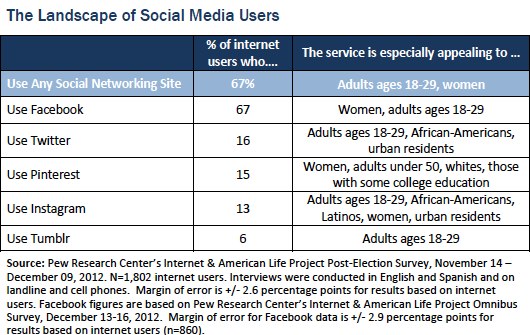
    The first thing to highlight is this year’s version of the annual survey on social media users, published on February 14th, 2013. The survey broke down demographics of social network use. The most telling chart they’ve got is this one:

    landscape of social media users

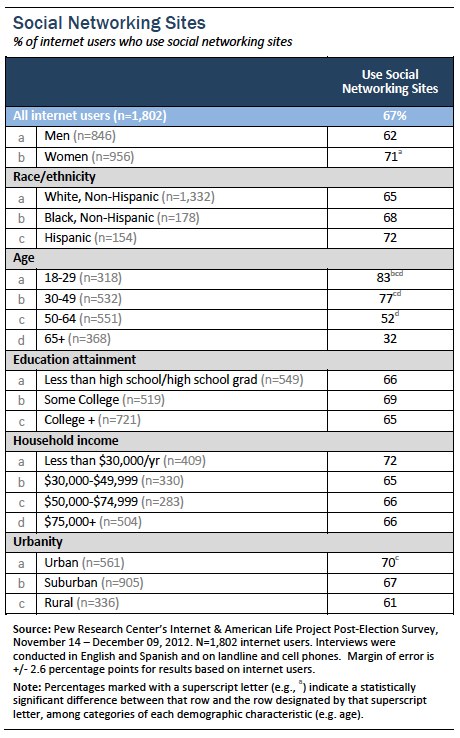
    Beyond that very focused look, the information about percentages of people that actually use social media is what is most interesting to me when presented as a case why government agencies should be online and interacting. Too often, government folks resist delving into social media because of an out-dated belief that minorities and traditionally under-represented demographic groups wouldn’t be able to access it. Yep, out-dated. Check this chart out and tell me where that belief stands today:

    percent of users

    Every “traditionally under-represented” minority group is over-represented in the survey. They use it more than those older, white guys. You know the ones, the older, white guys who traditionally make decisions about what format should be used to distribute information.

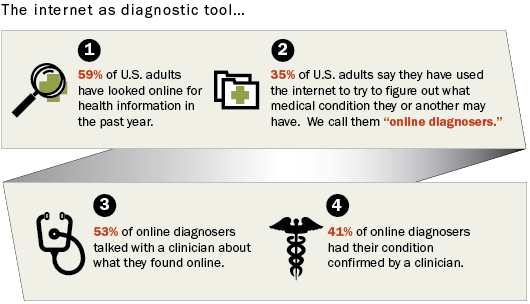
    Now for those of us in the health field, the rationale for getting into social media is even more compelling. These next charts are taken from the Pew folks’ Health Online 2013 report. The goal of that survey was really to find out the behavior of what they call online diagnosers. These folks have used information they’ve found online as a critical part of how they interact with the their doctor, in many cases even using the internet to prompt them to go see a doctor:

    ED72A0421D8745288A3AB5214258790B

    Additionally, they found that:

    Eight percent of internet users say they have, in the past 12 months, posted a health-related question online or shared their own personal health experience online in any way.

    Even more impressively:

    [O]ne in four adults (24%) says that they turned to others who have the same health condition during their last bout with illness, essentially the same finding as in our 2010 survey. One in four internet users (26%) have read or watched someone else’s experience about health or medical issues in the last 12 months. And 16% of internet users have gone online to find others who might share the same health concerns in the last year.

    The final report I want to highlight is on mobile health. They key part of this study are these following statements:

    Fully 85% of U.S. adults own a cell phone.

    One in three cell phone owners (31%) have used their phone to look for health information. In a comparable, national survey conducted two years ago, 17% of cell phone owners had used their phones to look for health advice.

    While this has HUGE implications for those of us who do emergency health messaging, it has even bigger implications for EVERYONE who does health messaging and information for this reason (taken from last year’s Digital Differences report):

    The rise of mobile is changing the story. Groups that have traditionally been on the other side of the digital divide in basic internet access are using wireless connections to go online. Among smartphone owners, young adults, minorities, those with no college experience, and those with lower household income levels are more likely than other groups to say that their phone is their main source of internet access.

    Like I said last week, the research supporting what I, and lots of other online geeks, have been saying for years is starting to come around. The research is there, we just have to find it.

  • The Power of Communicators

    As we start to get into the possibility of another pandemic, we’re faced with the need to explain it to the public. All of our risk communication muscles should be getting ready for battle (while hoping that we don’t need to actually use them!). The first thing we need to do it come up with a name: what the heck should we, the media, and the public call it? (Is this a fetish of mine? We’ve talked about it for coronavirus and hurricanes thus far.)

    The reason I keep talking about names is because they are so powerful. Aside from the Sandy it’s-not-a-hurricane-we-have-to-use-other-warnings disaster, there can be real consequences because of the words that we choose to use. We’ve all heard the swine flu to H1N1 flu ordeal, but besides confusion (which is admittedly something to avoid, duh), the damage can be much worse.

    Gwen Ifill, writing for PBS Newshour, understands the power of how we describe things, and what’s it means in real life:

    Wednesday was the worst of it. A suspect was arrested, we were told. He was in custody, we were assured. And the only description of the suspect was that he was male and “dark-skinned.”

    I tweeted this: “Disturbing that it’s OK for TV to ID a Boston bombing suspect only as ‘a dark-skinned individual.’”

    And the hounds of Twitter hell were unleashed.

    Conspiracy theorists on the left applauded me for what they saw as right-minded commentary on race in America. Conspiracy theorists on the right denounced me for what they saw as wrongheaded commentary on race in America. Both were wrong.

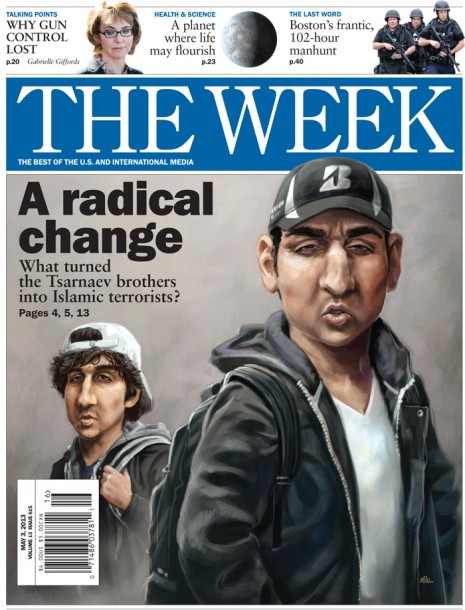
    47962_cover_full

    The wrongly-labeled color of the suspects’ skin immediately conjured images in everyone’s head. It confirmed bias where there was none, leading to a fracturing of the conversation, yes, but the worst was what it did to arm-chair detectives (and maybe even real-life detectives). Folks like Sunil Tripathi were pulled into the fray, smearing, fingering, jabbing at their good names. All because one of us, a communicator, slipped. Surely you can imagine the ongoing fear in the muslim, “dark-skinned” community, especially after the last decade of hate crimes directed at them.

    This is the power we have. We can literally move mountains. Positively if we’re thoughtful, negatively if we’re careless, and unproductively if we’re unclear.

    I like to think that we are learning our lesson. The CDC and WHO both got ahead of the naming problem of H7N9 influenza and released recommendations for calling it avian influenza A(H7N9) virus. A mouthful yes, but the only people who saw that name were the researchers and public health folks who communicate with clinicians. In a released document, they made allowance for alternate uses. Ways and situations it was appropriate to call it something else: H7N9. While this certainly isn’t going to do anything about news anchors shooting their mouths off, I think it’s an admission that the words we choose have real consequences and we need to consider all situations and listeners when we speak.