Category: Uncategorized

  • Silence is a Failure

    Yesterday, we talked about the Asiana Airlines Flight 214 and how social media sped up the public’s interest in the crash. Today, we’re going to talk about when the disaster is known. About how doing things the usual way is a recipe for a bigger disaster.

    The problem isn’t that people need life-saving information–especially in a situation like this. The problem instead is that people think you don’t care. We’ve talked several times about how, as communicators, trust is our currency. Trust is predicated on a belief that the person looking to be trusted understands, or emotes with, the person being asked to trust. If we look like we don’t care, who the hell would trust us?

    And that’s exactly the problem being faced by Asiana Airlines now. According to our new best friends at Simpliflying, it took SIX HOURS for Asiana to post a response on Twitter.

    They’re investigating? Investigating what? Then, two hours later, they issued a press release:

    But that delay didn’t mean that people weren’t looking for information. Indeed, their Facebook and Twitter followings shot up (see slides 25 and 27) in a way that most of us in the emergency world wish ours would.

    People were doing anything and everything to find information. And when they didn’t find it issued officially from the airline, they complained.
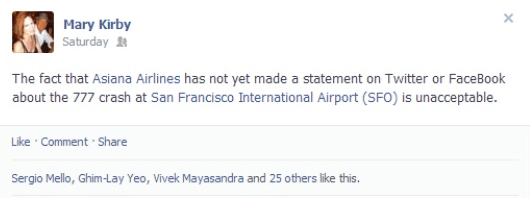
    kirby facebook

    And they’ve been reeling ever since. There is no sympathy for Asiana.

    But the part that has killed them is more than their silence. It’s the blast of communication from others that has made them look so out of touch.

    Boeing (slide 15), other airlines (slide 16), NTSB (slides 17 and 18, though, admittedly their star has dimmed a bit since the day of the crash), and finally San Francisco airport (who did a ridiculously amazing job keeping their customers informed of the situation). During this amazing outpouring of online empathy and information distribution, Asiana was silent. And it’s in comparison that what they did was so bad.

    Now think about the emergency you fear. When you take six hours to approve a tweet or a press release, will all of your partners and competitors and surrounding counties and states and agencies all stay silent, or will they make you look bad?
  • Crisis Communications at the Speed of Air Travel

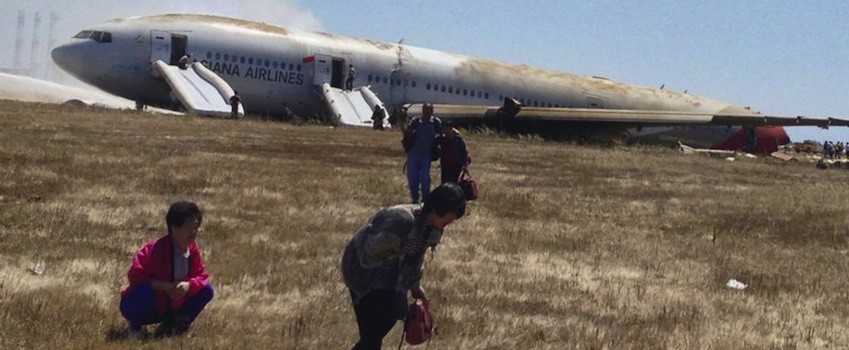
    sfocrashI like to impress upon people the idea that social media has sped up crisis communications. Where we used to talk about a newscycle, then a 24/7 newscycle, we now have a ten-second news cycle. Ten seconds is about how long it takes for me to pull my phone out, snap a picture and tweet it out. (I tested it, honest!)

    The classic example of this type of news breaking had always been US Airways Flight 1549, which crash-landed in the Hudson River. A passenger on a ferry snapped the famous picture of people standing on the wing of the plane, awaiting rescue. That picture was posted to Twitter before FDNY boats were in the water. Insanely fast for the times.

    This past week, we were reminded of how fast news breaks by the crash of Asiana Airlines Flight 214. A crisis communications consulting firm for the air industry released a phenomenal report detailing how social media shaped the disaster, and that’s where I’m pulling a lot of this post from. (You can find the excellent SlideShare of their presentation here, and their blog post here.)

    This was the first mention of the crash anywhere online:

    Now, if you notice the timestamp on that tweet and are familiar with the timeline of the crash, you’ll notice that the tweet was posted less than one minute after the crash. Simpliflying says thirty seconds post-crash. We now have a 30-second media cycle.

    And don’t think that first impressions can be swallowed up by more famous people. None other than Sheryl Sandberg of Facebook stardom posted that she was supposed to be on that flight. A Samsung executive who was actually on the flight posted images of the burning plane just 18 minutes post-crash. But Krista, our original tweeter, was still the center of attention. According to Simpliflying, she’d been interviewed more than 4,000 times in the next 24 hours.

    Many of the reporters reached out to her via Twitter. I’ve talking in the past about how reporters are using social media as sources, so think how far ahead of the story you’d be if you had some of those reporters in your Twitter lists and were monitoring them.

    Definitely check out the Simpliflying post in the meantime, because I’ll be talking about how Asiana Airlines totally blew it (and how we make the same mistake) tomorrow.

  • Your Agency’s Brand

    crowdI work in government. I know how much the title of this post bothers many of you. The little twitch you did when you read it. “We don’t need a brand, we’re the government; branding is for people selling something.”

    Like we don’t need people to know what we do; like we’re not selling something.

    Because we are selling something. We’re selling us. I hinted at this earlier, when we talked about how government is not competing against competitors, but against irrelevance. There is a cacophony of interesting information out there, much of it contradicting what we’re telling people, especially on the public safety/health/community side of things.

    We want people to eat healthier, we want people to exercise, we want people to start putting together a preparedness kit, we want people to volunteer in their communities, we want people to utilize our parks, to meet their neighbors, to vote, to turn off the TV. Think of the last ten commercials you watched: did any of them espouse these things? Each of them was researched, developed, molded, written, filmed and distributed to elicit the maximum amount of time, money and interest from exactly those things we want.

    We can’t compete with them. Simple as that. Try as we may, as good as our stuff is, as right as it is, Don Draper’s ilk are kicking our butts. And that used to be okay, because we were the government. People trusted us, believed in us. But that’s not the case anymore. So why should the public listen to us? Do they even know what we do?

    I’m sure at some level, they do know, but do they know the whole story? Often, government roles are misunderstood, or more perfectly, mis-underestimated. At a session at the NACCHO Annual Conference I attended last week (that I’m going to reference a lot going forward), one public health department found that the public thought their job was to give vaccines to poor folks and to inspect restaurants. That’s it.

    Now imagine that you live in that community, and you don’t get free vaccines (no, you pay full price), and your favorite restaurant just got shut down for some BS violation. How much would you support that public health department? When budget cuts came to the local legislative body, would you stand up and yell to make sure they kept their fair share of the pie? Of course not. Similarly, fire departments that people think are out-dated because there aren’t that many fires these days, mental health agencies that only deal with problem people, the list goes on.

    If no one knows what you’re doing, if you’re not seen as beneficial to your entire community, your agency’s head is on the chopping block. That’s the power of a branding effort. That’s what you can gain.

    https://twitter.com/jgarrow/status/355726427267661825

    And it’s not like you need to do expensive market research to see how the public sees you. When you’re presenting to the legislature, how many people show up to support you. Is your crowd bigger or smaller than others? Is it bigger or smaller than last year? Want something more quantitative, then look at your funding levels. What does the overall trendline look like? Is it positive or negative? Is it more positive or more negative than others?

    Folks, we need supporters. And the public won’t do it if we’re always seen as supporting “other people.” What do you do for the whole community?