
Category: Uncategorized

  • Public Health Podcasting

    microphoneFor those of you who are avid readers, you know that I’ve occasionally been doing video posts on the blog. (Here’s the first one from earlier this year.) They’re going … okay, I think. I’ve wanted to do something like this for a long time, and am finally getting it done this year. It’s been a fun experience, and certainly makes me think I’d like to do it more officially in the future. Looking forward, I should really admit that anything beyond the random videos that I don’t advertise could probably be considered a podcast.

    So, what’s a podcast? Well, according to Teagan Keating, it’s:

    A podcast is a bit like a radio show that you download from the internet.

    And it turns out there’s a bit of a market for it:

    People really do listen to podcasts. As of 2011, there were 91,000 podcasts. In 2012, Edison Research found that 29% of Americans polled had listened to a podcast at least once, and 26% had viewed a video podcast (sometimes called a vodcast) at least once.

    And just within the usually very-behind-the-times public health world, there are at least ten regularly updated podcasts, from places like the American Public Health Association and the US Department of Health and Human Services, but also individual public health practitioners like Jigsaw PSPH and Helen Osborne.

    So what does this mean for us as government communicators (and you, too, public health folks)? Well, after yesterday’s post about where people are getting their news, shouldn’t podcasting be considered yet another avenue through which we can spread the word? Yes, it’s not traditional, and yes, you won’t get ten million listeners. But you might get the one listener you need, or more importantly, the one listener who needs you.

    The great list that Teagan put together is woefully bereft of local and state health departments. And, given the insanely low threshold needed to produce one of these things (seriously, I do it with my phone and a five-dollar video editing app), why aren’t more government agencies doing it?

    (As an aside, I’m going to continue my video posts through the end of the year, and then I very seriously will consider spinning them, or an audio podcast, off next year. I’ll be attending the Philly Podcast Festival this week to learn about how I can do it better. Look for another update on the topic of podcasting in the near future.)
  • Non-traditional News

    A couple of days ago, we talked about the royal baby and how the news isn’t everyone’s news. Some of you, though, may be asking about where this other news lives. Well it lives everywhere, and that’s been demonstrated a few times this week online.

    First, television. Pop quiz: what network was the most watched during the recent July sweeps week amongst viewers 18 – 34 and 18 – 49? ABC? Fox? Nope. Try Univision. The Spanish-language network is seemingly commanding more eyeballs than any of the so-called “big guys.” But how much Spanish content do you produce?

    Second, internet. If you had to pick which internet giant consumed more than a quarter of all North American internet traffic, which would you pick? Facebook? Netflix? Nope. Try Google. In fact, Google (mostly because of their YouTube ownership) serves up more data than Facebook, Netflix and Twitter combined. But how many Google ads do you have? How many YouTube videos?

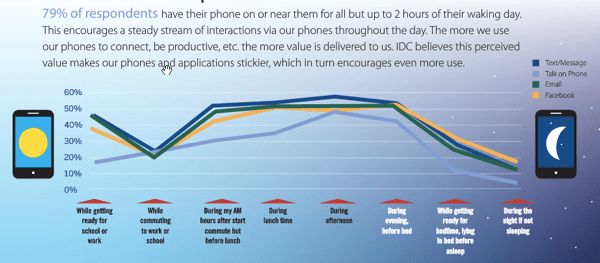
    Third, how people access information. According to the Pew Internet and American Life Project, in their latest survey, more than 56% of American adults reported being smartphone owners. And how do they use their smartphones?

    social-media-stats-phone-use

    They get online! All. Day. Long. According to the Buffer blog, more than 189 million people access Facebook via the mobile app. And then they ask this very important question that relates to our discussion of how people are getting their news:

    Rethink it: There are probably more users accessing Facebook from mobile devices than you thought. It’s worth considering how your content displays on mobile devices and smaller screens before posting it, particularly if your target market is full of mobile users.

    How do people get the news? They get it from anywhere and everywhere. And there’s no way you can provide information to all of these disparate sources. So–and this is the important part of the post–this is why your agency needs to be their own content creators and delivery system. You need to be the place that people go for information. Because the public is already building their information portfolio, and right now? You’re not a part of it.

  • Cameras Everywhere

    One of my favorite web comics is XKCD. It’s highly intelligent, quite nerdy, and published regularly. If you’re not already a reader, and have a background in mathematics, this needs to be a regular stop on your travels through the web. (And if you need help deciphering it, like I do sometimes, check out this great ExplainXKCD site.)

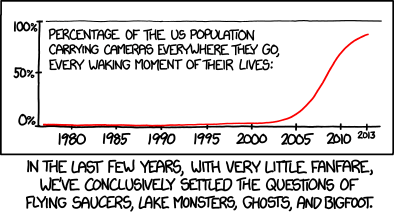
    The image above is taken from here on XKCD. The idea behind the comic is that many of the world’s mysteries are being solved, proven or disproven because evidence-making machines, specifically cell phone cameras, are nearly ubiquitous today.

    What does that mean for your agency? Well, quite simply there are cameras trained on your folks all the time. Right now, even.

    Our first reaction is that this is a bad thing. But is it? Not always, and maybe never. According to the NY Times, it’s been a boon for one California community:

    The Rialto study began in February 2012 and will run until this July. The results from the first 12 months are striking. Even with only half of the 54 uniformed patrol officers wearing cameras at any given time, the department over all had an 88 percent decline in the number of complaints filed against officers, compared with the 12 months before the study, to 3 from 24.

    Our friends on fire scenes are seeing the same thing. Chief Boyd describes a fictional scene where images are transmitted online at the same time that a chief on-scene seems them:

    Now fully engaged in unfolding events I can’t quite picture the exact location of this particular complex. So, I pull up aerial photos allowing me to see all four sides. Wait….. I can see a fire wall extending up through the roof near the address apartment. That’s good. Looking for more real time intel, I pull up the Washington State Department of Transportation camera network and quickly spot a camera pointed in the general direction of the “C” side of the apartment complex.

    We will be on camera all of the time, from here on out. Those fictions that we were worried about? We can now get proof that they never happened. Those mistakes that we make will be broadcast for all of the world to see. This is neither a good thing nor a bad thing. It just is. How we react will make all of the difference.