Category: Uncategorized

  • A Moment of Silence

    One of the very best conferences in the land started yesterday. And it started off with a bang. In one of the very first pre-conference workshops, Dr. Cynthia Baur of the CDC (she’s one of the world’s preeminent thinkers AND doers in the field of health literacy), said the quote above.

    Now, I’ve said just this for a long time: there is no general public. The general public has voluntarily carved themselves up into tiny little fractions of groups, each self-identified by some demographic that can change over time, isn’t necessarily exclusive from other demographic identifications and allows people to adopt multiple identifications all at once.

    Think about me and all of my unique interests as an example. I’m interested in public health, emergency management, horror movies, punk rock, Philly happenings, social media, running, tattoos and video games. Name me one other person you know that does all of those things (no, really, I want to meet them). Outside of work duties, I don’t follow the national or local news at all. Am I in the general public? What about you? What interests do you use to define yourself?

    That information you’re putting out? The one written for the “general public?” Does it fit into my interest spectrum? Probably not. And it probably doesn’t fit into lots of other interest spectrums, either. But why do we keep writing for the “general public”?

    Like most things, there’s a rational reason why we started messaging this way. It has to do with the history of our information dissemination pathways. Government communication to the wide public really took off as mass media was reaching the height of it’s popularity and utility. If you wanted to talk to the public in any widespread fashion, you could knock on doors, or send a release to the mass media. And the media made no bones that they were the way to reach everyone. There’s no need to develop specific messages when you’re just talking into a great big, fat pipe.

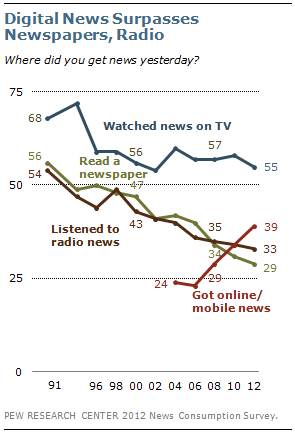
    Things have changed a bit, though, if you haven’t noticed. People have diversified where they get their news from:
    9-27-12-1

    People have found that big, fat pipe no longer satisfies their need for relevant information. And they’ve since moved on to targeted, specific, interesting information and news. And yet, we still write like the mass media is the only way we can get information out. The general public only existed when there was one way to get information. With a plethora of ways to get information today the punk rock, zombie movie fan, public health professional set has chosen to ignore your messages designed to appeal to everyone from eighteen-year-olds, grandparents and mothers of young children.

    So let’s bow our heads for a minute and put this out-of-date idea to rest, finally.

  • Nothing’s Happened

    One of the great exhortations, one of the absolute must to-do’s given during emergency public information classes today is that you have to let the media know when your next update is coming. Lots of folks even go so far as to say, “when I know something, you’ll know something.” (And between me and you, I’m a big fan of that.) But when you do those pretend little exercises in the afternoon of the class, the instructor always tilts her head at the end of your “press conference” and asks, “When will we know more?” And before high-fiving his newly-roped-into-this teammates our spokesman dismissively says, “We’ll have another press conference in four hours.”

    Nobody asks what do you do when nothing’s happened. Almost without fail, these exercises are quickly developing scenarios that will have updates in a few hours. But what about when the situation is slowly developing. So slowly that, like a drop of pitch, updates are few and far between? I’m looking at you public health. How do you tamp down expectations and tell people, “Nothing’s happened,” and reasonably expect them to not believe you’re hiding something. I mean, people are dying here, man!

    Well, Kevin Jump, on the other side of the pond, says we need to make updating about nothing the norm:

    And this is the problem – as it turns out (because I had to go), B&Q [ed. note: a sort of Home Depot] is open normal hours on the bank holiday, but their site doesn’t tell me that, because nothing has changed so they have ‘nothing’ to tell me.

    A simple “we are open as normal on bank holiday Monday” would have answered all my questions

    This reminded me of my little election experiment last week, when I looked at a few random councils to see how they had done elections. Once or twice in the process I went to a county council website, and found nothing about elections at all. That’s because counties run elections on a four year cycle, and this year was (for these councils) not one of those years – so no elections. The districts had elections, but the county sites didn’t tell me that (quite a few county sites don’t acknowledge the existence of the districts).

    We’re too much focused on making sure that the media knows what’s going on. Hence the exhortation to make sure they know when things have changed. They’re not interested in what’s not changed. Non-changes don’t bleed, so they don’t lead, so to speak.

    Instead, we need to focus on our publics. We need to let them know the information that is relevant to them, not just interesting to the media. No less a blogger than Greg Licamele has said something very similar in a great post recently:

    The whole public affairs enterprise needs a different focus if we want to remain relevant to the people we serve rather than becoming more irrelevant to journalists who have a different purpose.

    What do you do when nothing’s happened? Make sure that everyone knows, not just the people who increasingly don’t care.

  • Surge Capacity

    A couple of days ago, I traveled to Washington to speak at one of the premiere social media and emergency management conferences of the year. The National Capital Region’s Regional Emergency Support Function #15 holds an annual NCRSMEM summit, focusing on new, novel and interesting uses of social media to help respond to and prepare for disasters. If you didn’t have the opportunity to follow the extremely active hashtag, Brandon Greenberg put together an extremely handy-dandy Storify of the day.

    It was an amazing day. With speakers from all levels of government and the non-profit world, and topics ranging from Hurricane Sandy to the Moore tornado to the Boston Marathon bombings, I’m sure everyone in the room learned something. While lots of topics came up over and over again, one really stuck out to me: the realization that the resources we bring to bear to respond to disasters, especially around social media, are simply not enough. We simply cannot handle the volume of data, requests and interactions that social media requires to be successfully used during an emergency.

    From FEMA requiring more than ten people on social media just for rumor monitoring during Hurricane Sandy to the Red Cross distributing their social media presence to public affairs folks at every local chapter to Boston PD asking for and promptly getting overwhelmed by the amount of crowd-sourced video surveillance being submitted, the story was the same. Heck, I remember when the FBI posted images of the bombers on their website, and it promptly crashed and was out commission for hours due to the insane amount of traffic going to the site.

    Government cannot handle the public information side of a disaster anymore. Full stop.

    But, as we saw yesterday, neither can the private sector. Now, in all honesty, the situations are different, but when the New York Times website and associated news distribution tools went quiet for nearly an hour, it demonstrated that information dissemination is hard. There are so many technological balancing acts going on that a flaky scheduled update can take down one of the world’s most trusted names in news–during a massive assault by the Egyptian military that killed scores of people. (Read a bit differently? During the worst possible moment.)

    But instead of throwing their hands up in the air and declaring that they’d lost, the Times staff took advantage of the distributed nature of the internet and continued to post stories and updates. They just did it on Twitter and Facebook. According to The Verge:

    For the next hour, the account tweeted news from Egypt, but as the site remained down, full stories began being published — this time as long updates on the Times’ Facebook page. While live-tweeting is a common way to break news, under normal circumstances, social media is a way to draw people into a site, not a substitute. Indeed, not long after, service was restored, and the pieces were added to the main site.

    It is for this reason, and the reason quoted by Boston PD Deputy Commissioner John Daley (that when they asked IT to make regular updates to the website, they were given a timeframe of days to weeks, so they created their own blog), that we’ve updated our emergency public information plan to explicitly call for distributing information dissemination to many digital outlets. We specifically mention Facebook and Twitter, and creating a situation-specific blog, but also explicitly encouraging distribution through other, unmentioned digital channels. We’ve also specifically written in the ability to depend on digital volunteers (like VOST and the Red Cross Digital Volunteers) to surge staff.

    Your next emergency will overwhelm your agency. And as we already know, surging during an emergency is impossible. So, what are you doing about it today?