Author: Jim

  • 9/11, Anthrax, and Life in Public Health: Part 3

    The following is the last in a three-part guest post series by Scott
    J. Becker, MS, Executive Director, APHL. This post can also be found
    on the APHL blog
    here
    .

    Thank you again to everyone at APHL and especially Mr. Scott Becker.

    During this period, APHL experienced a surge in media interest, as it
    quickly became apparent which labs were doing the anthrax testing. We
    went from maybe three media calls per year to up to 60 per day. I
    made the decision that APHL should not shy away from media attention,
    instead we should let the media tell our story. But I knew that we
    couldn’t keep up this pace so I asked the board to approve a one time
    deficit spending of up to $30,000 for crisis communications support.
    How did I arrive at that figure? It seemed like a number that would
    fly – and it least it was a place to start. Following board approval,
    I contacted the only director of communications I knew, Jody DeVoll
    (then with AMCHP) for advice. She stayed on the phone with me for
    over an hour, coaching me on the nuances of media and ended by saying
    “you need Jill Merrick, and you need an intern just to handle the
    incoming calls.” Jody is Angel #1. Jill Merrick is a communicator
    extraordinaire. She was my godsend back then, and now I consider her
    a good friend. Jill called me to say, “Jody called me and told me
    your situation, how can I help?” Jill was in our office the next day,
    and our own media induced chaos became more manageable, and most
    importantly it became more strategic. Jill is Angel #2. I gave one
    interview on WCBS News radio in New York City about the use of anthrax
    home test kids that were being sold on the internet (I said that it
    was a bad idea). Nancy Kaufman, an executive at the Robert Wood
    Johnson Foundation heard the interview and called to ask if there was
    something they could do. “For sure, “I replied, “we need funds to
    help pay for crisis communications support.” Nancy is my third angel.
    Within days, I had a grant to cover our communications needs, but
    with one caveat. We were told that we must produce a communications
    plan for the association but the added commentary was “we don’t think
    that you can really do much with it, after all it’s only labs you deal
    with.” To me, those were fighting words. Not only did we create
    that plan, but we proved them wrong, very wrong. About a year after
    the anthrax attacks and subsequent media maelstrom, APHL hired its
    first director of strategic communications – Jody DeVoll, also known
    as Angel #1. Jody now heads up a four person strategic communications
    team. The public health lab system rose to the occasion that fall,
    testing over 125,000 samples for anthrax contamination.

    The fall and winter of 2001 ended for me with a much needed two week
    vacation. On December 26, 2001 USA Today ran a multi-page story about
    labs and anthrax, complete with a quarter page photo of Kati Kelley,
    the Connecticut state laboratory director (and one of my public health
    heroes).

    Shortly after the new year, my daughter Sophie began to utter her
    first few words. They were “dada,” “mama,” and “antrax.” It was at
    that moment that I realized what toll these events took on me, having
    been absent so much of Sophie’s first year. Someday Sophie and her
    younger sister Ali may read these words and realize how important it
    is for me to serve the public’s health through APHL, and how my small
    role and bearing witness helped shape me as a parent and as a
    professional.

    Through planning, long days and nights, excellent science (some
    admittedly “on the fly”), and the dedication of some of the most
    committed public servants in America, we made it through that dark
    fall and winter stronger because of the experience. The experiences
    of 2001 helped us better serve the public through other health threats
    in the past ten years – West Nile Virus, SARS, monkeypox, Hurricane
    Katrina, 2009 H1N1 Influenza pandemic, and the Deepwater Horizon (Gulf
    Coast Oil Spill) accident.

    The unsung heroes of public health, laboratorians, hold my greatest respect.
  • 9/11, Anthrax, and Life in Public Health: Part 2

    The following is the second in a three-part guest post series by Scott
    J. Becker, MS, Executive Director, APHL. This post can also be found
    on the APHL blog
    here
    .

    CDC worked up messages that states should be communicating with their
    hospitals and physicians to request immediate notification of any
    patient who showed symptoms of anthrax and forwarding of any specimens
    to the state lab for analysis.

    The following week and a half was a blur – anthrax was detected in a
    second AMI employee. Swabs were taken from their facility and found to
    be contaminated as nasal swabs were taken from many other AMI
    employees. Anthrax was then detected in New York City (as if they
    haven’t been through enough!) and in Washington, DC at the Hart Senate
    Building. We kept a running dialogue with our members, checking on
    their needs and with the CDC investigators. That week we also began
    to hear of several “white powder events,” as we now call them.

    On Friday, October 19th at 5:00 pm I received a call from CDC’s senior
    lab advisor, Dr. Jan Nicholson, asking if we could quickly arrange a
    50-state call with all state lab directors as CDC wanted to share
    information with us. We contacted every state and held the call at
    6:30 pm – during which we learned that the CDC linked the four
    confirmed cases of anthrax to “intentional delivery of B. anthracis
    spores through mailed letters or packages”— the US postal system was
    the delivery mechanism for the anthrax.

    Now that anthrax was seemingly everywhere on the East coast, we were
    more than on alert, we were set to action. A major gap was uncovered
    during the 50-state call – there was no standardized protocol for
    testing for B. anthracis from an environmental sample, only a human
    clinical specimen. So we created one over the course of the weekend.

    From Friday night through mid-day Sunday, APHL members and CDC
    scientists developed a protocol by working through the days and
    nights, handing off the still draft protocol to the next team in the
    next time zone, until the protocol was deemed by CDC anthrax leads to
    be ready for prime time. Prime time turned out to be Monday morning.

    Sunday morning I was on a call with Dr. Nicholson and was asked if we
    could meet with Postal Officials that evening at their emergency
    operations center in DC. Very fortunately, APHL’s then-president Dr.
    Mary Gilchrist was already en route to DC for other meetings and was
    able to join me. Knowing how the government works, I didn’t want to
    the two of us to be outnumbered, so I enlisted Carol Clark,APHL’s
    chief operating officer, to join us. The APHL band of three entered
    the USPS headquarters at 8:30 pm and met with a team of five officials
    all of whom looked like they hadn’t slept for days. Truth was, they
    hadn’t.

    CDC was beginning to be deluged with specimens from the postal system,
    so private clinical labs (which had no protocol) were testing
    specimens for anthrax; state labs were getting inundated with objects,
    powders and some of the strangest things one could imagine for
    testing.

    The postal officials were questioning Dr. Gilchrist, a world-class
    microbiologist and architect of the LRN, about spore size and how far
    spores could float. She, in turn, was asking them about the mail
    handling process. She described how spores may go towards
    electrostatic charges, charges that would be present as mail went
    through a machine that essentially “pounded the hell out of the
    envelope,” as was described to us.

    Carol and I worked with Mary to devise a plan to bring some order to
    the chaos that was ensuing in mail facilities across the country. We
    learned about the process of mail flow and incorporated terms like
    “upstream and downstream” facilities into our lexicon. We established
    that by mid-week APHL would deploy a lab system coordinator to the US
    Postal Service part time and that the person would work from APHL
    offices in downtown Washington the rest of the time. We initially
    figured we would need a coordinator inside USPS for a few days per
    week for a few weeks. We enlisted Tony Sambol who serves as the
    bioterrorism lab coordinator for the Nebraska Public Health Lab to
    come to DC. Tony and his boss, Dr. Steve Hinrichs, readily agreed to
    the arrangement. Tony arrived the following Wednesday, and it was a
    full month before we saw him at APHL. He never left the USPS ops
    center, there was just no time.

    The USPS was looking for order out of chaos and we delivered. Tony set
    up a system of communication and coordination for the high threat
    samples (as deemed by postal inspectors and/or FBI) to quickly reach
    the closest LRN lab capable of testing and that wasn’t inundated at
    that moment. All of this required knowledge, dedication, nerves of
    steel and excellent communication – all of which Tony possessed. APHL
    was contracted by the USPS for this testing. LRN support was still
    fairly thin so this arrangement allowed the LRN labs to conduct the
    testing without worry that it was draining state coffers or limited
    grant resources.

    Lab directors were fully supportive of this system. They knew they
    were under the gun to deliver quality results to the public as quickly
    as possible. The labs were on the frontline in the war against
    terrorism because it was within those labs that answers were housed.
    The public health labs were the only ones who could determine if
    anthrax was present or not.

    These were some tense times. I was told to be on a call (and ensure
    that Dr. Gilchrist was on it too) with some state epidemiologists who
    were very concerned and angry that their state lab was being “used” by
    APHL for fee-for-service postal testing….It seemed that even a few
    weeks into the events, the public health community was not yet
    convinced of how real this threat was. Fortunately, just before the
    call, cooler heads prevailed, and, as I understand it, some East coast
    epidemiologists supported this system because they were seeing the
    chaos first hand.

    The next few weeks were some of the craziest of our lives. Anthrax was
    seemingly everywhere. Rural towns, big cities, the Hawaiian Islands,
    State Department outposts around the globe all had anthrax scares.
    Nowhere seemed off limits to the ubiquitous white powder. It wasn’t
    only white powders and false alarms, the lab system also detected the
    real deal. Anthrax was in newsrooms in NYC, the Senate office
    buildings, and portions of the postal system. It was discovered that
    a 61 year old health care worker succumbed to anthrax, as did a 94
    year old woman who rarely left her home. Contaminated mail was the
    working theory and remains so today.

  • Via Patrice’s Picks: Boston Police Zombie Notification

    Media_httpuploadsneat_teqcl

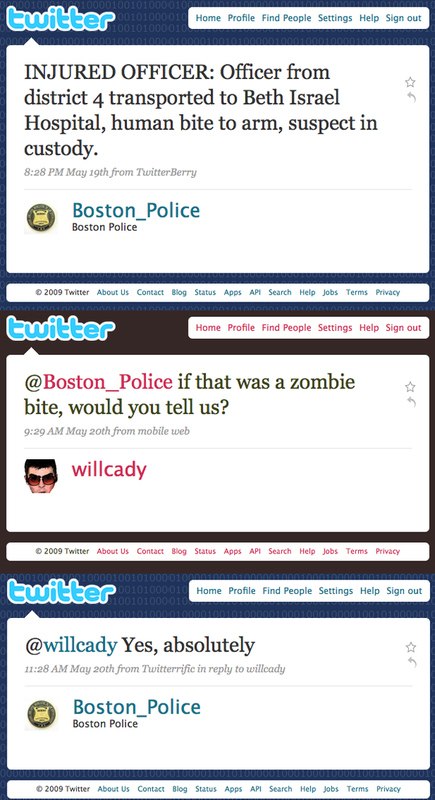
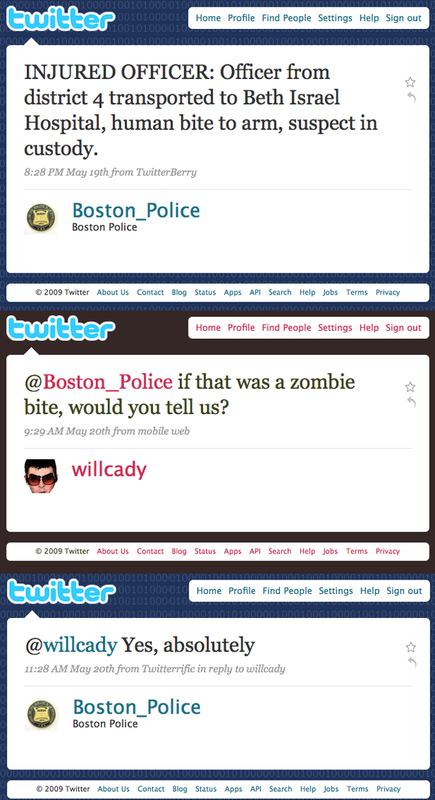
    Hat tip to the amazing Patrice Cloutier (@patricecloutier) for this amazing image of how to do public affairs correctly.

    Whoever was staffing the Twitter account that day could have easily ignored the question from Will Cady (@willcady), but chose to respond directly in a way that demonstrated transparency and approachability.

    Pros and cons?

    I see no cons. This tweet didn’t go out to all Boston Police Twitter followers, because it was direct at Mr. Cady’s account, so no one else was bothered by a less than serious tweet. And unless there was a extensive approval process, it wasn’t a burden on the Police Department’s time or manpower.

    Pros? Mr. Cady’s got a great, POSITIVE, story to tell about the Boston PD. Every zombie nut in the US is virtually high-fiving BPD. And now you’re hearing about it in a congratulatory fashion. Free positive PR for a local police department? Sounds good to me.