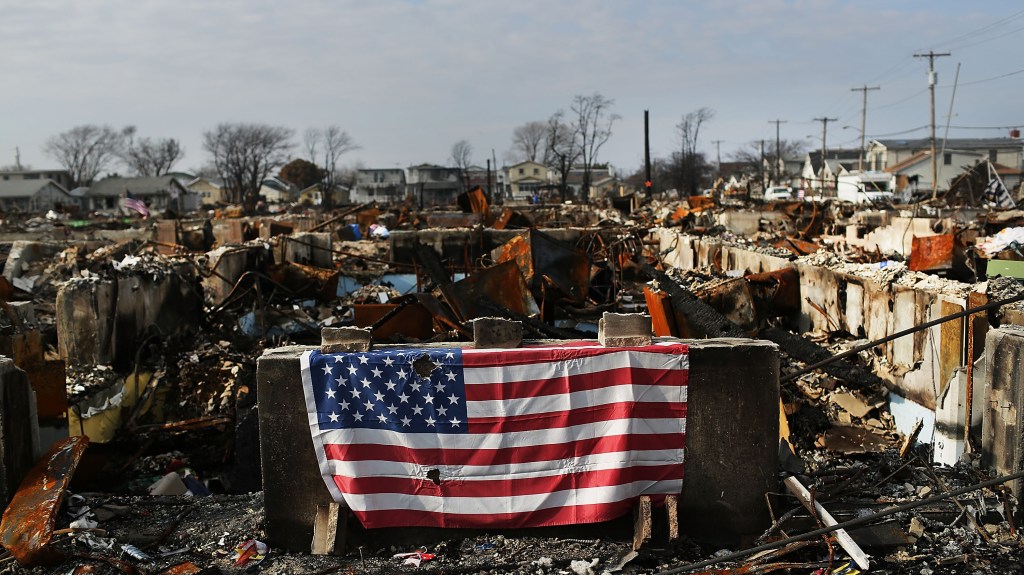
I don’t think anyone would say we live during a peaceful time. Bad news permeates the airwaves and broadsheet. This isn’t exactly new, of course (though there is some evidence of an increasing number of weather-related disasters due to climate change), but our perception of this bad news has changed.
We no longer experience disasters third-hand. We experience them in real-time, in living color, with no filter or delay. The advent of social media and mobile devices has brought disasters into our living room, on our bus rides, into those moments when we are quiet and peaceful.
This phenomenon is something that really started on 9/11. Because of the breaking nature of that disaster, the fact that it took place in the city with the most media in the US, and the delay from start until terrible, terrible finish means that many of us were watching at some point. In the days following, the news media showed loops of the disaster, over and over, attempting to try to make sense of it all.
And we haven’t stopped with the violence and tragedy since. The first picture of the Boston bombings I saw was of a blood-stained street. We all remember that iconic image of the children in Newtown being lead through the parking lot, covering their eyes. The images are burned into our memory and while most of us grieve and move on, that isn’t always the case. Sometimes those images hurt more than is healthy.
Liz Halloran, of NPR, published a piece recently that (besides being an example of how I wish I could write) described what we’re putting ourselves through:
But this time, in our full-on, post-Sept. 11 surveillance society and freshly Twitterized media, we were able to experience each event in excruciating, exquisite detail.
Through the saturation of social media, we were also able to experience it equally, whether reporting from the streets of Boston or the scorched explosion site in Texas, from newsrooms in New York or Los Angeles or Berlin, or from our own living rooms and college dorm rooms.
This week, these awful events have cemented the reality that the media is now everyone, anyone with a computer or a smartphone, a Twitter account or a Facebook page.
Ms. Halloran speaks of the public, of the great us. While I’m obviously concerned about them, my first concern is with those of us who work in this field. Who, whenever the bell rings–anywhere in the world–get on social media and start tracking. We see all of the images. All of the video. The stuff that doesn’t make it onto the news. From the ground. From the scene. Shot by cell phone cameras that look scarily like our own. In neighborhoods that look scarily like our own. By people who look scarily like we do.
We know it’s wrong. And the research bears out that this isn’t healthy. But we don’t need research to know that. We have the nightmares. We check on our kids in the middle of the night, just to make sure they’re sleeping peacefully. Unfortunately, there is no critical incident stress management team or experts for wounds inflicted via social media. This is a great tragedy in the making.
It’s also an opportunity for behavioral health supports to take the lead after a disaster. Not on a scene, but in the world. To support the public, to support the responders, to support the virtual responders. And maybe we’re seeing it already?
https://twitter.com/PhillyRecovery/status/324955789787820032
 Public Health Affairs