
Author: Jim

  • Irrelevance

    earsWhen I imagined the future of government communications, I would envision morning meetings, where the comms team (ha!) gets together, each over their own personal blend of Starbucks or locally-sourced coffee (double ha!), discusses what news is breaking, reviews where the competitors are and what their goals might be, then the team lead blesses the talking points for the day and everyone dashes off to their well-appointed, yet obviously industriously worked-in offices (triple ha!).

    Aside from the fact that I obviously dream about some fantasy-land, there’s more wrong with that statement than is obvious. You see, I talked about our competitors and how my fantasy comms team would defeat them gloriously, just in time for happy hour. While it’s obvious that very few folks in government communications are concerned with our competition, and it’s even more obvious that our competitors number more than most of us can count to, that’s not the problem. You see, our biggest problem isn’t losing the battle of our public’s minds and action to some nefarious industry or trade group, it’s losing that battle because no one’s heard us. It’s losing because we’ve become irrelevant. It’s that we’re not number three or four on our public’s priority list, it’s that we’re number 100, or 1,000.

    A consultant that I follow on Twitter, Steve Woodruff, had a brilliant post on exactly this topic a couple of weeks ago, and I just couldn’t shake how his message, while crafted very explicitly for the consulting world rang just as true–maybe more so–for government communicators.

    [Y]our biggest competition isn’t the competition. It’s the noise in your client or prospect’s mind. It’s the boss – the kids – the schedule – the office politics – the latest health problem – the job search – the fantasy football league – tomorrow’s big presentation – the upcoming vacation – the overloaded e-mail inbox.

    Don’t believe me? Monitor what’s coursing through you brain for the next 2 minutes. See what people who are fighting for your attention are up against?

    Now I know I just said that we don’t care about the competition, so you’re thinking, “how does this relate to us?” It relates because we’re worse than those consultants that are so concerned with what other consultants are doing. We’re worse because we (to a large degree) still think that our messaging is the only game in town. That we speak and, as we’re the government, people should listen. We shout into that ether with full faith and belief that our message resonates above all other messages. But it doesn’t work like that.

    Want to know how I know? Go back to that little two-minute exercise Steve had you do. Now think about the last message you published for work. Where did the action that message implored you to undertake rank in your two-minute ordering of life? Was it one or two? Three or four? Or more like 100 or 1,000?

    And the cacophony of life is only increasing. More social networks, both in meat-space and cyberspace, more responsibilities, more deadlines, higher productivity, fewer financial cushions. You know what we need to be concerned with?

    The signal-to-noise ratio. How do we put forth such a clear signal that we stand out in the minds of our clients?

    So, how do YOU do it?
  • Get Out of the Way

    weather reports
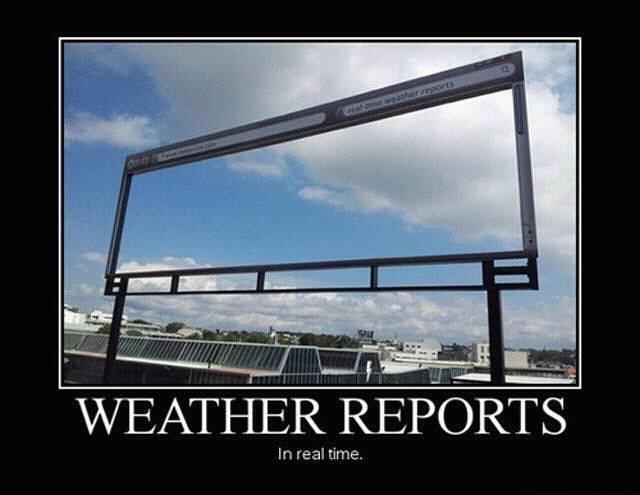
    We are very lucky to have an amazing independent weather outlet in the Philly area. The folks at Phillyweather really get into the science of the weather and why it affects us in a particular way. When forecasting, they’ll make a call, but only after presenting all of the models and possibilities. They present the weather then get the hell out of the way. Which, if you ask me, is much better than the rigmarole you see on most morning newscasts.

    The image above was tweeted from their Twitter account recently, and it really struck a chord with me. While I think that most PIOs understand that we need to get out of the way and let the doctors and chiefs and subject-matter experts do the talking, I wonder if even that small bit of control (talk now, not another time) is too much.

    Think about it this way: message control does not cover just the message (the what, basically). It’s also about the who, the when, the where and the how. Who speaks, when they speak, where they speak and how it’s said all tell volumes. For my seasoned PIO friends out there, how many fights with news agencies have you gotten into over just those questions? These things are important because they affect how the message received and perceived.

    Now, I’m not saying we should allow our employees to call up the media whenever they want and spout off on whatever topic comes to their head. Far from it. I think, though, that there is a middle ground. And that’s because of what social media gives us.

    Your agency’s blog (you do have one, right?) is probably full of posts by your Executive, or your communications staff. (Or really hopefully at least there are some posts.) And then something newsworthy happens and you ask a subject-matter expert to write about it. In a format that they’re not familiar or comfortable with, under a deadline that they feel stressed about, and to readers who don’t know this lady from a hole in the wall. This is supposed to be helpful?

    My point, and it naturally follows from last week’s post on having others write for your agency, is that we need to get the hell out of the way. Let your agency shine through every day. Give your experts the podium they deserve. Build them a following (or let them build a following).

    Everyone who does the work we do knows the world is changing. Our traditional gatekeepers–the media–are going away, getting fired, or getting outgunned by citizen journalists. That means that the role that they provided us with (being a medium upon which we could conduct messaging to the public) is going away. This is the next true calling of PIOs and communicators: to be the media through which the public and our agency’s really smart guys and gals can talk.

  • Federal Government Spying

    By now, I’m sure you’ve heard the news. The federal government has been caught red-handed snooping through your cell phone calls and your internet interactions. I’m sure that by the time this publishes, there will be further revelations and much blame, laid at the feet of just about everyone including the White House, Congress, whistleblowers and the American public.

    While the topic concerns me greatly, that’s not the facet of this absolute disaster I think is relevant to you all. (I plan to conveniently ignore the legality or illegality of the topic today.) For us and our ilk, I think this classic saying best describes what’s happening now:

    Trust takes years to build, but seconds to destroy.

    And unfortunately for many of us who work in government communications, I worry that the public will concentrate on the first part of that description of us (government) rather than the second (communicators) in light of this most recent, and latest in a series of unhappy events.

    I mean, it’s not like we’re that highly trusted now, right? According to the worldwide, annual Edelman Trust Barometer, the US government is trusted by less than half of its public. You think this disaster will help?

    Government Trust

    What do we do when we have no trust left? This is not your fault, or my fault. (I check the logs, no one from the White House or Congress reads this blog. Hi NSA!) But we are the ones that have to deal with the fallout. We’re the ones who shout life-saving advice and recommendations into the ether, with nothing more than the cloak of, “they do this job because they are true believers; it’s certainly not for the money,” to protect us from the liars, the sycophants, the paranoid and the deniers. What do we do when that last shred of trust is gone?

    Years we’ve spent building trust and relationships and good vibes, only to be painted over by the broad stroke of a brush meant for someone else. Someone who stepped too far, someone who took a bit too much, someone who is not us.

    I don’t have an answer. All I have is the heavy sigh of a government employee who has seen this show before, who is too tired of fighting upstream every day just to do good in the world. What do we do when all that we’ve ever had going for us is gone?