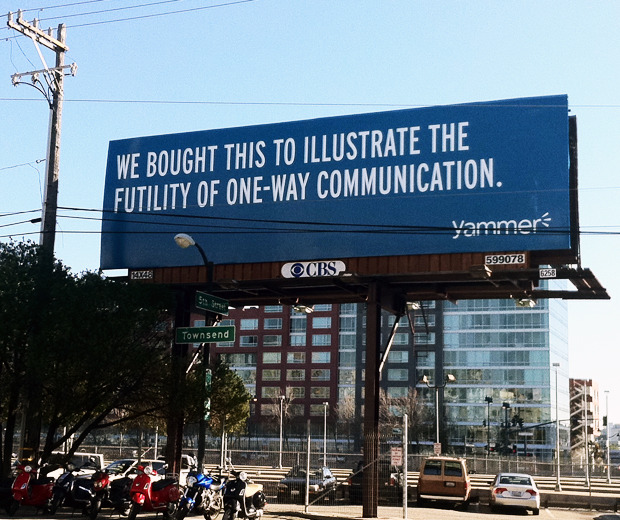
via techcrunch.com
I really don’t think I can add anything to that. But I do know this will make a great slide in someone’s #SMEM presentation.
I really don’t think I can add anything to that. But I do know this will make a great slide in someone’s #SMEM presentation.
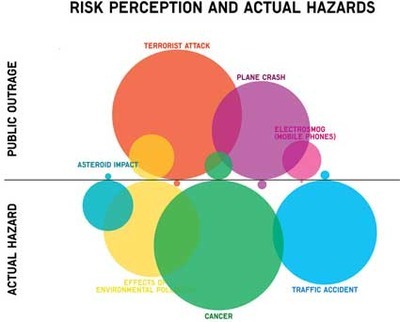
This seems very relevant to this crowd, though I’ll qualify my posting it here to show that I think it’s a poorly designed chart.
The chart attempts to show the disconnect between actual risk and perceived risk. One place it falls down is in conflating personal and societal risk. Cancer is an very large personal risk. Millions of people will be diagnosed and die due to cancer every year. But is it really four times the risk of an asteroid impact? On a personal level, no, because four people don’t die from cancer for every one that dies from asteroid impact. That said, on a societal level, the destruction wrought by an asteroid impact (a big one) is such that it may be comparable to the effects of cancer. And would you really argue that the threat of an asteroid impact is ten times that of airliner crashes?
Couching all of that, I appreciate what the chart is trying to accomplish. By pointing out the disconnect between what people are afraid of and what is actually threatening to them, it can help realign priorities. Focus should be shifted to prepare for and mitigate against that which can cause real harm (read: not asteroid impacts).
Risk perception disconnects are something that is well-known, and relatively well-studied. The CDC’s Crisis and Emergency Risk Communication course teaches us the following reasons why some things are feared beyond their possible threat:
>- Voluntary risks are more readily accepted than imposed risks.
>- Risks controlled by the individual or community are more readily accepted than risks outside the individual’s or community’s control.
>- Familiar risks are more readily accepted than unfamiliar risks.
>- Risks generated by nature are better tolerated than risks generated by man or institution.
>- Reversible risk is better tolerated than risk perceived to be irreversible.
>- Statistical risks for populations are better tolerated than risks represented by individuals.
>- Illnesses, injuries, and deaths spread over time at a predictable rate are better tolerated than illnesses, injuries, and deaths grouped by time and location.
>- Risks that do not single out a group, population, or individual are better tolerated than risks that are perceived to be targeted.
>- Risks generated by a trusted institution are better tolerated than risks generated by a mistrusted institution.
>- Risks that affected adults are better tolerated than risks that affect children.
>- Risks with a well-understood potential benefit and the reduction of well-understood harm are better tolerated than risks with little or no perceived benefit or reduction of harm.
Helpful tips from a not wholly helpful chart.
Crisisblogger Gerald Baron had a New Year’s Agenda post up right before the holiday that I really enjoyed. As with all of his musings, I highly recommend you take a few moments and read it over.
One of his top issues really resonated with me, and is something that I’ve been thinking about since the Deepwater Horizon disaster last spring and summer.
- Operation and communication functions coming together.
In the past, the public communication function through the EA Officer or PIO was largely separated from operations. Not any longer. See point 2. Public participation and active involvement in response decisions, such as deployment of key resources, is changing the very nature of operational response management. Through social media, a hyper-aggressive media, Billy Nungesser-type local political leadership, the line between the response organization and the citizens its serves is getting very fuzzy. Communication leaders who know their stuff will be key to managing this kind of involvement and will become an increasingly vital part of the Command staff.
As I watched that event unfold, I couldn’t help but be struck by the intricate dance between Operations and the JIC. To be completely honest, it was this relationship that germinated the seed that ultimately grew into this blog. No matter how well the operational response was going, the public’s perception (fed by the mass media) was of massive failure.
While such a disconnect occasionally happens, in this case the public’s frustration manifesting in ways that could have (may have) negatively affected operations. Responders cleaning up the shorelines had to deal with spectators, journalists and citizen-journalists intent on seeing how BP was destroying the environment. I remember, in particular, one reporter submerging himself in oil to show how much was present on the shoreline. Not only was this dangerous for the reporter, but if a responder was there and tried to intervene, it’s very likely they would have been hurt. All of this, just because people believed that BP wasn’t doing everything they could have.
I started to think back to my ICS training, about where ICS came from and why it was structured as it is. Those of us who have taken weeks of our lives to learn the ins and outs of ICS know that it came about as a result of poor coordination to widespread wildfire response in California in the 1970’s. During a particularly bad season, firefighters from across the West were called in to assist with the response. The result was multiple chiefs not accountable to anyone, confusion in terminology, and a lack of overall coordination. People died as a result of poor coordination. Thus, ICS was developed to help better organize multi-agency, multi-jurisdiction emergencies—and especially the ramp-up from normal operations to emergency operations. It’s actually rather ingenious, if you understand the theory and implementation. I’m quite in awe.
Now, think about the information needs of the time. News happened at 6pm, 11pm, and 5am the next morning. Updates on wildfires included the name of the fire, estimates of how much it’s spread and how contained it is, and if any buildings are threatened. On the risk communication side of things, there may be an evacuation call as well. Unless it threatened a movie star’s house or took lives, it didn’t really affect the national media.
Contrast that with today’s media, and citizen-media, where you have thousands of news-makers with virtually unlimited reach reporting on your every step—and misstep. And this isn’t just for huge events, it happens during traffic stops and political fundraisers and routine press conferences and during snow emergencies.
I advance the idea that today’s media environment is completely different than the media environment that ICS was developed in. Aside from increasing capacity (see: incorporation of the Joint Information Center, media center and ESF 15), there has been no fundamental change in how PIOs act within the ICS structure. I wonder if the change in how the world interacts with the public information component of modern organized response should necessitate changes in how modern organized response creates and disseminates public information. Has public information become part of operational response?
I’ve talked with colleagues at the local and federal level about this idea, (start ICS) about moving public information out of the Command staff and placing them under the Operations Chief (end ICS). No one thought it was a good idea. They felt that the direct relationship between the Incident Commander (IC) and PIO was vital to speed information releases. But I find that there is already talk in social media circles about how getting social media messages approved by the IC is too slow, so I don’t see how that relationship will continue to be sacred.
So, this is where I stand. I think that public information is increasingly an operational part of disaster response (and that’s not even talking about how operationally vital public information is during a public health emergency). I wonder if segregating Operations and public information could threaten both efforts.
This is obviously not very well fleshed out, and I’m not even sure it’s a good idea. But I think that if someone like Gerald Baron is hinting at it, there might just be something to this crazy way of thinking.
I always appreciate feedback, but especially in this case I encourage it. Please comment below, send me an email, or reach out to me on Twitter.
 Public Health Affairs