Author: Jim

  • Whole Community: Functional Needs Communities

    I’m in Lisle, Illinois this week presenting on social media at the 2013 Whole Community Preparedness Conference, sponsored by the Illinois-Indiana-Wisconsin Combined Statistical Area. I wanted to talk this opportunity to talk about messaging to our whole community messaging and making our messages easier to understand and receive. As the week goes on, I’ll update this post with links to the other posts.

    New York City has been in the news recently, and not in a good way. A federal judge ruled that New York violated the rights of people with disabilities in their emergency response planning for not adequately accommodating their needs in a disaster. The original lawsuit was filed in response to the City’s response to Hurricane Irene, and has caused serious consternation in the disaster planning community because so much of our planning has focused on making disability-specific plans, or because so many of our plans are focused on doing the most good for most people.

    This lawsuit follows a similar one filed a few years ago in Los Angeles.

    I am NO expert in evacuation or shelter design, so I have no advice for your planners. But I have some background in communications, so I have a recommendation: video. I know that your first reaction is that video doesn’t sound like it would apply to all of the functional needs communities, but done correctly, it can. Take this video from the Deaf Hearing Communication Centre as an example:

    This video adequately provides critical life-saving information for the deaf and visually impaired communities. Can you imagine if the video was captioned to allow for non-auditory presentation? Or what about captioned in Spanish to help Spanish-speakers?

    Videos, because of their ability to convey visual and auditory information are perfect for reaching multiple audiences for one outlay. We’ve talked about, and demonstrated with some of my video posts, how easily it is to create videos. But what about the captioning? It turns out that’s pretty easy, too. Here are instructions for adding captions to YouTube videos.

    Since we really should stop planning for “regular” communities and “special” communities and start planning for the whole community, and since our funding is continually getting cut, we need to figure out ways to streamline our efforts while addressing everyone’s concerns and needs. Videos like those from DHCC are pointing in the right direction and will hopefully become a standard tool in the communicators toolbox.

    Whole Community #1: The New Digital Divide
    Whole Community #2: Approachability
  • Whole Community: Approachability

    I’m in Lisle, Illinois this week presenting on social media at the 2013 Whole Community Preparedness Conference, sponsored by the Illinois-Indiana-Wisconsin Combined Statistical Area. I wanted to talk this opportunity to talk about messaging to our whole community messaging and making our messages easier to understand and receive. As the week goes on, I’ll update this post with links to the other posts.

    smd

    One of my favorite bloggers in the whole world is also one of my favorite tweeters (Perhaps not coincidentally). Wendy Sue Swanson, or as she’s known on the internet, Seattle Mama Doc, dispenses daily information on health, health care and life raising kids.

    I love Dr. Swanson’s real life approach to communication. There is nary a poorly-lit head shot of some white coat to be found anywhere. Her Twitter feed is full of pictures, personal stories, links to health care stories and–gasp–conversations! Dr. Swanson is a real person! That’s step one, and it’s a big one, though really it shouldn’t be.

    Her blog, though, is what I want to focus on. It’s a testament to how healthcare providers and healthcare organizations should be blogging. It demonstrates the very essence of approachability.

    Blog posts about emotional wellbeing start off like this:

    I’ve had an enormously stressful week or so. Seriously maxed out in a way I haven’t been in some time — smooooshed if you will. The reason I mention my stress is that I’ve found in the past, like this week, these stressful episodes are often peppered with moments of mindfulness that penetrate into my life and stick.

    Thankfully there are buoys around us that get us through these stressful episodes. A joke our child makes while running by, a story on the radio that allows us to pause, the simple beauty of a red tree passing into sight on the side of the road. Sometimes when we’re most amped and stressed our lenses on life de-fog in a way where the beauty is just crystal clear.

    Or a video post about violence in movies:

    I was in fourth grade when Red Dawn debuted as the first PG-13 rated movie back in 1985. At the time Red Dawn was released, it was considered one of the most violent films by The National Coalition on Television Violence, with a rate of 134 acts of violence per hour, or 2.23 per minute. And although not every PG-13 movie has had significant violence (think Pretty in Pink) it turns out PG-13 and gun violence have become close bedfellows over the last 28 years.

    Yes, she writes beautifully, but the reason she writes so well is because she writes from the heart. The blog posts aren’t full of stern faces and finger-wagging. It’s fun and engaging and personal. And successful. There’s a lesson we can all learn from that. A lesson about approachability.

    Whole Community #1: The New Digital Divide

  • Whole Community: The New Digital Divide

    I’m in Lisle, Illinois this week presenting on social media at the 2013 Whole Community Preparedness Conference, sponsored by the Illinois-Indiana-Wisconsin Combined Statistical Area. I wanted to talk this opportunity to talk about messaging to our whole community messaging and making our messages easier to understand and receive. As the week goes on, I’ll update this post with links to the other posts.

    I’ve written about the so-called digital divide before, when I said:

    If you ask about going online at home, on a desktop or laptop computer, using a non-dial-up service, there is a divide. Because computers and broadband access are expensive! But when you ask if people get online, there is less of a divide. And the reason why is probably sitting on your desk, in your pocket or in your purse right now: smartphones.

    And the research continues to pile up showing just that. Recently, the folks at Pew released some very specific data about Philadelphia’s digital divide:

    The report found the proportion of Philadelphians with Internet access has been steadily rising since 2011, when about 76 percent of residents were plugged in, compared to an estimated 82 percent who have access now. The trend appeared to cut across all races, with roughly the same proportion of white, black and Hispanic respondents reporting having web access.

    Study authors hypothesize the upward trend is due, in large part, to the growing availability of web-enabled mobile devices. Sixty-five percent of respondents reported using cell phones to access the Internet, up from 45 percent in 2011.

    A FIFTY percent rise in mobile web access in only TWO years!?

    And this data is borne out in national data, as well. Pew’s 2013 survey on broadband found the same thing:

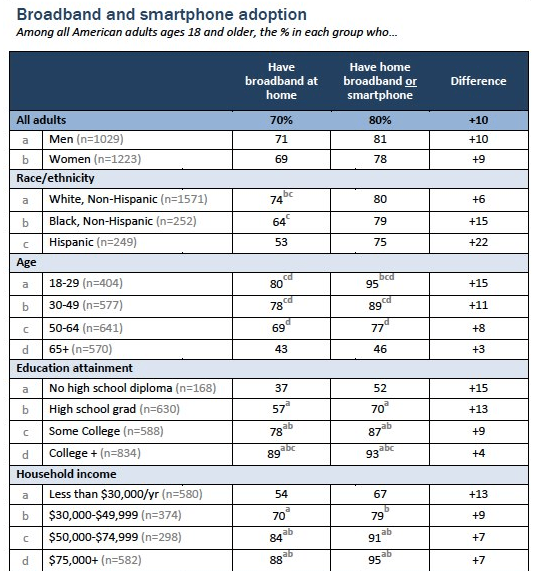
    Including smartphones in the definition of home broadband access helps narrow the differences between some demographic groups, but widens the gap between others. Differences between racial and ethnic groups are an example of smartphones narrowing the “broadband gap”: While blacks and Latinos are less likely to have access to home broadband than whites, their use of smartphones nearly eliminates that difference.

    broadband and smartphones

    Getting back to the Philly data, we can see where the real digital divide is at:

    But the greatest digital disparity, by far, existed among age groups. Ninety-four percent of those aged 18 to 34 reported having Internet access, compared to just 54 percent of those 65 and older.

    For communicators who are resisting embracing digital communication for fear of alienating minority communities, the data to back up that point simply doesn’t not exist.

    Now, that does mean that we’re hitting elderly populations less than younger populations, but still, look at the percentage of 65+ that access the internet taken from this page (showing 2000 and 2011 data) and this page (showing 2013 data):

    2000 broadband access among 65+: 12%
    2011 broadband access among 65+: 41%
    2013 broadband access among 65+: 43%

    This is a rapidly rising percentage, and one that will only increase over time. Plan to utilize digital tools to become the centerpiece for your communication efforts one day (and probably sooner than you think).