Out of a sense of helplessness, I am resurrecting this blog.
The world feels awful and scary. And so little of what is going on makes sense.
I have so many emotions and fears bashing around in my head, I need to get them out. Before, blogging helped me deal with that when things were bad. When I thought things were bad.
I fear if I don’t say something — even if it’s just screaming into a void that no one reads — I’ll be able to make some sense of it. Or at least not feel as complicit in my silence.
I’ll be focusing on public health issues, and public affairs issues, from here on out. I imagine there will be no shortage of things to write about on where those two topics meet in the coming years.
And, as always, the works contained herein are my own personal thoughts and are not sanctioned, reviewed, approved, or otherwise associated with my job or career.
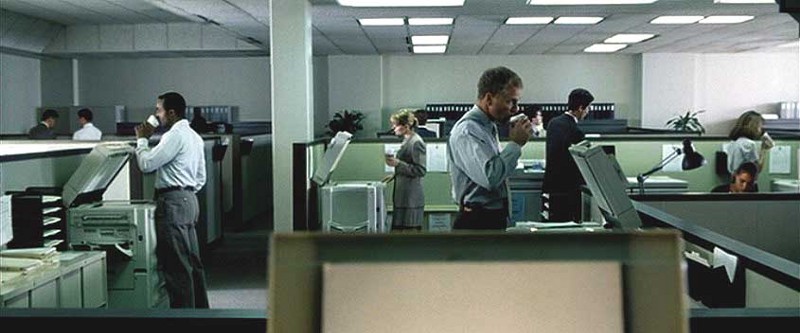
The title of this post is obviously the classic line from the 1999 flick, Office Space, and has come to define so much of how we understand what happens in industries that we don’t understand. We gaze over the tops of rows upon rows of light gray cubicles in back offices in office parks in suburbs from sea to shining sea, and wonder how many of these people are actually working. How many contribute to the bottom line and, conversely, how many get paid to take orders from the customers and pass them to the organization’s doers?
In private industry, we dispassionate observers can forgive some of the organization’s “people persons” taking up space because the company is still making money (or else, we’re told, they would quickly be out of business). We don’t know exactly what it is they do, but somebody in charge has a need for them, and in the black box of business, that’s acceptable.
But, what about in government? Remember, in government, they work for us, we pay their salaries, dammit! So when we peer over the slightly (or not-so-slightly) out-of-date light gray cubicles full of government workers, is our reaction as forgiving? Are we as dispassionate as observers? What the hell are they all doing?
Okay, sure, I’m not talking about the cops or the firefighters. Or the DEA, or the nurses, or the letter carriers, or the drivers, we get their jobs. They are government widget-makers. They do an easily definable thing that has an input (salary and benefits) and an output (criminals in jail, mail delivered, fires extinguished).
But, the rest of you, you government workers. What is your job about? How much solitaire have you played today? If you’re all done screwing up healthcare.gov, why haven’t you started providing the rest of us with an easily quantifiable, tangible thing that we can point to and say, “Your job is productive, you may stay.”
As a government worker with a very ill-defined job in the very poorly-understood field of public health, I’ve been promised that when the pitchfork-wielding anti-government head hunters come calling, my office is near the top of their itinerary. I’m no nurse or doctor, my car doesn’t have flashing lights or sirens, there aren’t really any concrete answers to the problems that I work on. Squishy is how I define my job. Relativistic.
But. It’s important work. And so is all of the work that my colleagues do. The accountants and human resources folks. The epidemiologists and sanitarians. The record keepers and front-line office staff. And it’s not just in public health, the same bias of assuming that government office workers are somehow less acceptable than private industry office workers permeates us all.
Where are all the stories about what’s gone right? The stories about the kids who don’t have asthma because we’ve cleaned up the air? The stories about the disease outbreaks that never get started because everyone is vaccinated? The stories about the restaurants that are closed before a single person spends two days moaning, a vomitous mess, on their bathroom floor?
Where are the stories that detail the epidemiologist seeing disease trends shift to a new zip code, which prompts the department to shift their condom giveaway program and six months later sees the incidence of those STDs drop back to normal?
They don’t exist. This isn’t to say that positive government stories don’t exist, they do. But they are overwhelmingly about some fancy new initiative. And if you can interview a twenty-something-year-old who’s applying private industry techniques to government work, it’s that much easier. But nothing about the day-to-day slog. Nothing to combat the negative stereotypes that so many of us hold.
So, this means that if government workers want their story told, they need to realize that no one but themselves will do it. The only chance to fight against negative stereotypes and work toward rebuilding their image lies in doing it themselves. Because thy’re government and they can’t count on some fancy PR firm to come in and spruce things up. (Unlike private companies can.)
This is an image rehab that won’t be conducted with a slick mass media marketing blitz, but instead will be successful only if one person sees the value in the work being done, and helps convince a friend. It will be done slowly, and at no cost, and not consistently, and often not well. But it will be done. It will be done, or those lactation consultants won’t be around much longer to ease new mothers fears, and those inspectors won’t be there to make sure the public pool is clean enough to swim in (if there even is a pool still).
So, what about you? Are you that person that sees value in the work that faceless, nameless government automatons do? Have you said anything to your friends about how they’ve kept you safe? Or are you just waiting for it to get really bad before you start helping?
Which means that all of the myriad social networking support groups and blogs and websites and feeds that I follow each come out with their annual statistics on the size and scope of social media and what trends are coming and who’s swinging the most wood after raising Series C funds. And there’s usually a drop-shadow-less infographic that tells me some tip about how to make my pins more pin-tastic and that 65.4% of all B2B partnerships thrive due solely to LinkedIn conversations.
And I read them all. Because it’s my job.
And I’ve yet to glean ANYTHING useful out of them.
1,440,000,000 people on Facebook. 77,600,000 Instagram users in the US. 4,000,000,000+ views on YouTube every day.
Lovely. Wonderful. But what does that do for my organization? Nothing.
The problem comes down to the maturation of social media. When the field was young and needed to prove itself, it sold eyeballs. How many people can see your posts!? Follower counts were like gold. Every time the “Facebook nation” rose up the ranking list of most populous countries, we forwarded those stats to our executives and pleaded to stop being kept from the promised land.
But now, when I post to Facebook, when I want to talk to the 3,876 people who have taken a half a second to click that happy thumbs up icon on our Page, when I have something that could potentially save their lives, their health, their humor, and/or their sanity, I’m lucky if 387 people ever see that post.
Sad Clown Mark Holthusen Photography. Photography by Mark Holthusen
Maybe I’m not as funny as I think I am. Maybe not.
Today, though, I’m not concerned with how many people could see my posts. Telling me there are 15,000,000 pairs of eyeballs out there waiting for my posts doesn’t do anything for me. Because I know 15,000,000 pairs of eyeballs aren’t waiting for me.
What’s waiting for me are the twenty people in my city that are thinking about quitting smoking today. Or the 4,000 people that would be interested in free yoga on the Parkway. Or the 150 that need to be reminded not to leave their kids in the car because it’s 95 degrees out.
We need new metrics on engagement and interaction. We need new advice for today’s social media. So I call on you, Social Media Expert/Maven/Ace/Superhero Person/Group/Blog (honestly, I tried so many combinations there, but they’re all already taken by real people)! Instead of selling us on how to get 10 zillion views using your One Simple Trick! on social media, help us learn how to find the right people and get the right people to ENGAGE with our social media.
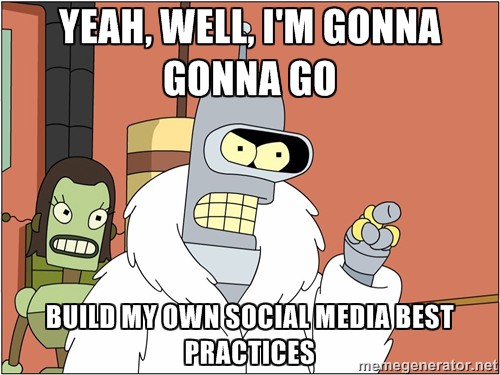
Until you guys start doing that, I’m swearing you off. I’ll make my own damn social media best practices that work for my audience.






 Public Health Affairs